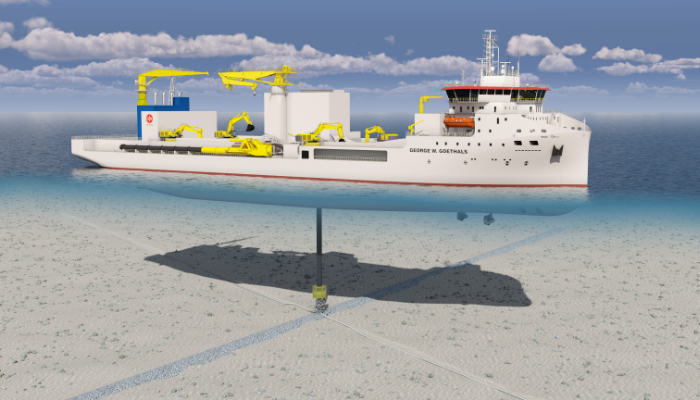
Belgium-based marine contractor Jan De Nul Group has confirmed the order of a new state-of-the-art rock installation vessel, the George W. Goethals, designed to protect subsea energy and data infrastructure. The vessel, which will join the company’s high-capacity fleet including Joseph Plateau and Simon Stevin, will be capable of deploying more than 30,000 tonnes of rock to safeguard offshore cables and pipelines. Equipped with advanced fall pipe systems, it will operate at depths of up to 400 meters, providing flexibility for offshore wind farms, interconnectors, and data transmission routes.
The George W. Goethals is being built as an ultra-low emission ship, featuring a hybrid powerplant, selective catalytic reduction systems, and diesel particulate filters that remove up to 99% of harmful particles. Its engines will run on biofuel and green methanol, aligning with the company’s sustainability strategy. Four electrically powered excavators onboard will enable rock loading without external support, enhancing operational efficiency.
Jan De Nul emphasized that the vessel represents a major step in protecting critical subsea infrastructure at a time when offshore wind and data networks are expanding rapidly but face increasing risks from natural hazards and sabotage. Philippe Hutse, Director Offshore Energy at Jan De Nul, said the investment reflects the company’s determination to meet these challenges: “Protecting the infrastructure that supports offshore energy production and transmission is essential. With this new vessel, we are shifting into a higher gear to meet that challenge head-on.”
The company is also expanding its fleet with two extra-large cable-laying vessels, Fleeming Jenkin and William Thomson, which will support the growing demand for long-distance interconnectors. Together with the new rock installation vessel, these additions strengthen Jan De Nul’s role in securing and enabling the global offshore energy transition.