Search
Close this search box

China Retains Shipbuilding Lead Despite U.S. Port Fees and Policy Push, CSIS Report Shows

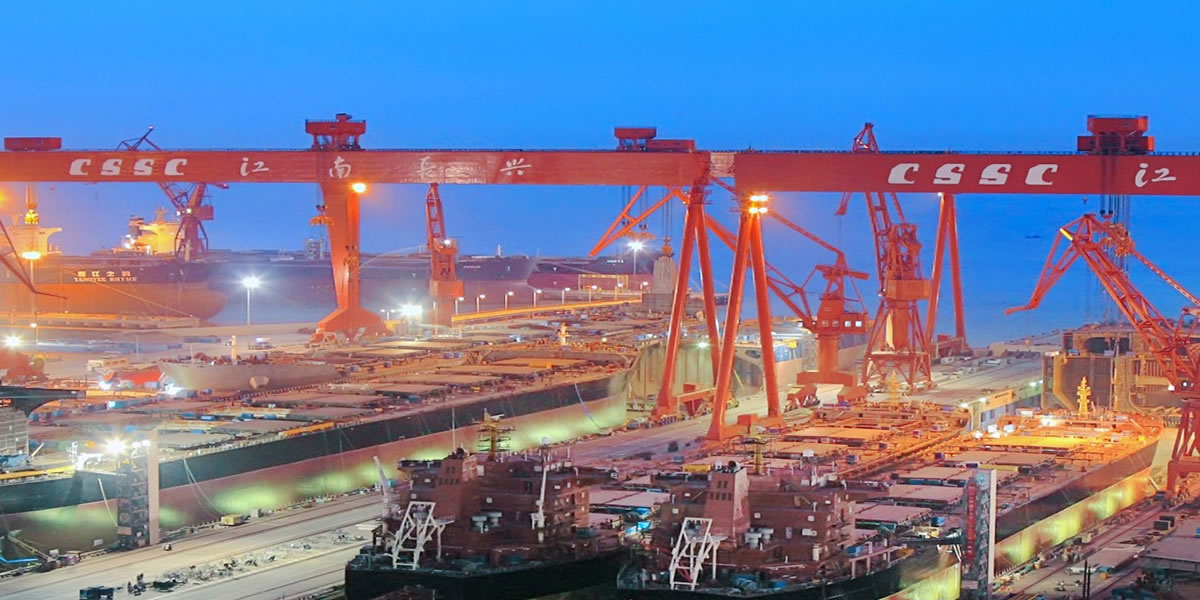
China continues to dominate global shipbuilding despite new U.S. port fees, according to a CSIS report. The analysis highlights that Chinese shipyards account for over half of new vessel orders in 2025, underscoring Beijing’s resilience against Washington’s trade measures.
Chinese shipyard cranes with containership under construction despite new U.S. port fees
Chinese shipyards continue to lead global vessel orders in 2025 despite new U.S. port fees, CSIS report shows. (Image Source: CSSC)

SHARE ARTICLE

The United States has stepped up efforts to curb China’s dominance in global shipbuilding, but new data suggests that Chinese shipyards remain resilient despite recent U.S. measures.

A CSIS report released on September 24, 2025, highlights that China controls over half of global shipbuilding orders this year, even after Washington announced steep port fees on China-linked vessels. The study, drawing on S&P Global data, shows Chinese shipyards accounted for 53 % of global tonnage in new orders between January and August. That figure, while lower than the 73 % surge in 2024, remains consistent with pre-tariff levels.

The U.S. port fees, which take effect on October 14, 2025, impose charges on vessels built in or operated by Chinese entities. For a large container ship, costs could exceed USD 1 million per first U.S. port call, with higher rates scheduled through 2028. Washington aims to leverage these fees to support its struggling domestic industry — U.S. shipyards delivered fewer than 10 commercial vessels last year compared with China’s output of more than 1,000.

Despite these moves, global carriers like MSC continue to commission new vessels from China; MSC alone ordered 12 containerships after the U.S. Trade Representative unveiled the fee structure in April. Some operators, however, are adjusting routes to keep China-linked ships out of U.S. waters.

CSIS analysts, including Brian Hart and Matthew Funaiole, note that while U.S. policies initially rattled markets, the shipping industry appears to be pressing ahead with Chinese orders. They warn that China’s integration of commercial and naval shipbuilding raises broader security concerns, underscoring Beijing’s ability to expand its navy alongside its commercial fleet.

For Washington, the challenge lies not only in balancing trade policy with industrial revitalization but also in addressing the strategic risks tied to China’s dual-use shipbuilding capacity.
Editorial Note:
This article was prepared with the assistance of AI tools to enhance clarity and efficiency.
All information has been reviewed and verified by the HMT News editor.
Three merchant vessels including MAYUREE NAREE, One Majesty, and Star Gwyneth were reportedly damaged on 11 March near the Strait of Hormuz, raising renewed concern over maritime security and crew safety in one of the world’s most critical shipping corridors.
The IMO has urged shipping companies to put crew safety first after attacks on merchant vessels in the Strait of Hormuz caused seafarer casualties. The agency also warned operators to use only confirmed information when making navigational decisions in the high-risk corridor.
Seafarers on IBF-covered ships can now refuse voyages through the Strait of Hormuz and the wider Middle East Gulf after the threat level reached its highest category. The new arrangement includes repatriation rights, two months of basic wage compensation, higher pay in the zone, and doubled compensation in death or disability cases.

Subscribe to HMT WEEKLY

Receive HMT WEEKLY in your mailbox.

Heavy Marine Transport News, Delivered Daily — Stay informed on shipping, offshore, and global logistics.

SECTION

INFORMATION

CONTACT

For general inquiries and to contact us,
please email: info@hmt-news.com