Equinor and Aker BP have established a collaboration focused on Norway’s tight reservoirs, aiming to make more discoveries economic to develop and increase hydrocarbon recovery. Announced on 26 October 2026, the initiative combines technical development with standardisation and coordination across their portfolios.
The work will cover exploration prospects, discoveries and development projects. Each company will put forward opportunities for joint assessment, including work to mature resources towards development and improve well stimulation. The partners will identify where common technical approaches and shared experience can be applied across several projects.
A joint management structure will oversee the programme, supported by teams bringing together specialists from both companies. The partners also want a steadier, more predictable flow of activity that can sustain the skills and supplier capacity needed for additional tight-reservoir developments.
Aker BP chief executive Karl Johnny Hersvik said the work would start immediately. He said considering the portfolios together could accelerate learning, reduce costs and broaden the use of jointly developed solutions. Kjetil Hove, Equinor’s executive vice president for Exploration & Production Norway, said common solutions could also speed up the development and qualification of technology.
The companies cited a Norwegian Offshore Directorate estimate that mapped tight reservoirs on the Norwegian Continental Shelf offer potential recovery of around 2.8 billion barrels of oil equivalent. They compared that volume with the resources expected to be recovered from Johan Sverdrup.
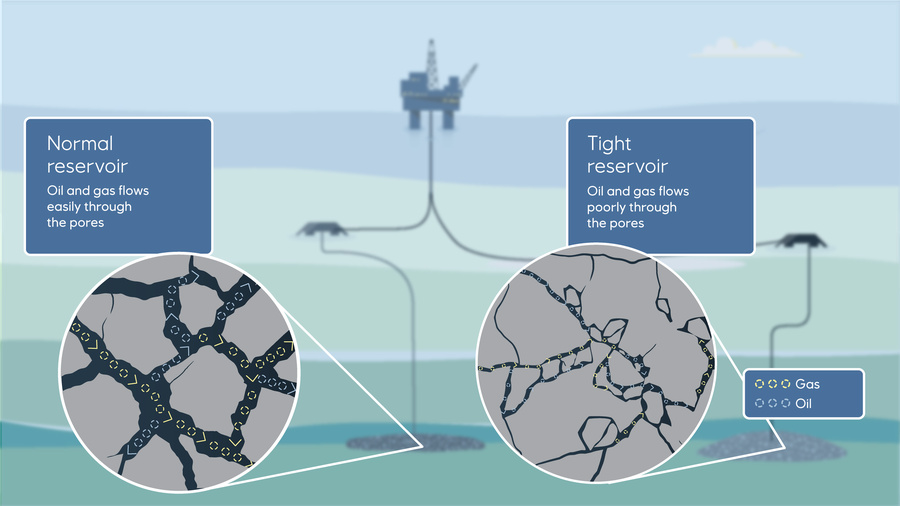
Tight reservoirs restrict hydrocarbon flow because the rock has low permeability. Conventional methods can recover only a limited proportion of the resources, and many discoveries remain too expensive to develop with available solutions. According to the companies, many of the approximately 90 discoveries still without development approval are in tight reservoirs.
The directorate has encouraged operators to collaborate on technology, common standards and knowledge sharing to address these constraints.
In its official announcement, Equinor also referenced the directorate’s 2019 estimate of 12–13 billion barrels of oil and gas in place in mapped tight reservoirs. This is an estimate of resources present in the reservoirs, distinct from the potential recoverable volume.
The recovery figures cited by Equinor differ by reservoir rock. For limestone, average recovery is estimated at 20% for oil and 30% for gas, with ranges of 5–40% and 10–50%, respectively. For sandstone, the estimates average 12% for oil and 25% for gas, with respective ranges of 4–20% and 18–40%.