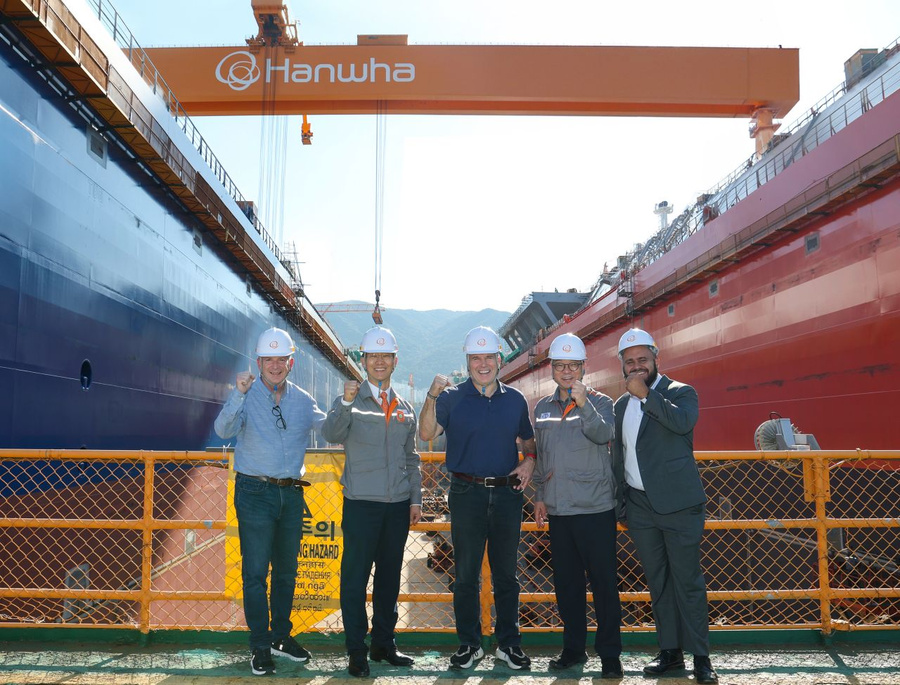
Hanwha Ocean is extending digital production systems and welding automation developed at its Geoje shipyard in South Korea to Hanwha Philly Shipyard in the United States.
The work is proceeding alongside an infrastructure expansion at the Philadelphia facility. It includes the introduction of production management software, welding robots and workforce training linked to ship construction involving the two yards.
Development of enterprise resource planning and production management systems for the Philadelphia yard began in November 2024. Full-scale implementation started in March 2025, and deployment is targeted for November 2026.
Welding robots used at Geoje are also being introduced at Hanwha Philly Shipyard during 2026.
Hanwha Ocean and Hanwha Systems completed their $100 million acquisition of Philly Shipyard in December 2024. The transaction had been announced in June of that year.
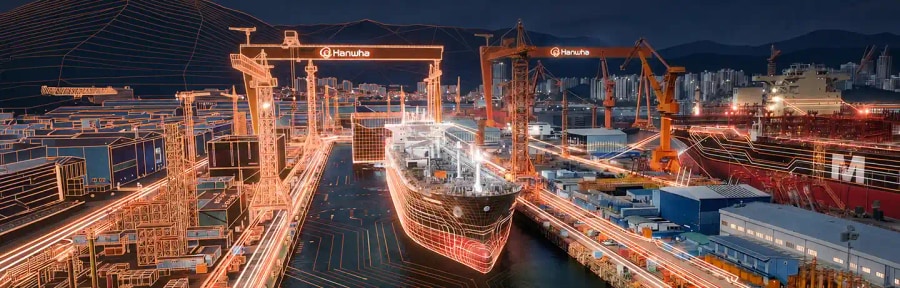
The systems being extended to Philadelphia were developed for a production environment covering about 5 sq km at Geoje. Multiple vessels are built across the site, while steel blocks move between fabrication, outfitting, painting and installation areas.
A Digital Production Center consolidates information from across the shipyard. Drones and internet-connected sensors refresh block locations and production data every 30 minutes.
Production teams use the information to monitor the location and status of ship components. Simulation tools are also used to examine possible disruptions, including severe weather.
The digital system extends to vessel testing. During sea trials, the Smart Sea Trial Center allows personnel onshore to monitor vessel performance, fuel consumption and equipment data.
Welding is another focus of the Geoje smart yard programme. Large commercial vessels are assembled from hundreds of steel blocks, requiring extensive welding throughout construction.
Small variations between steel plates require welders to adjust their angle, speed and movement. Hanwha Ocean records the working patterns and decisions of experienced welders and uses the data to train AI-supported systems.
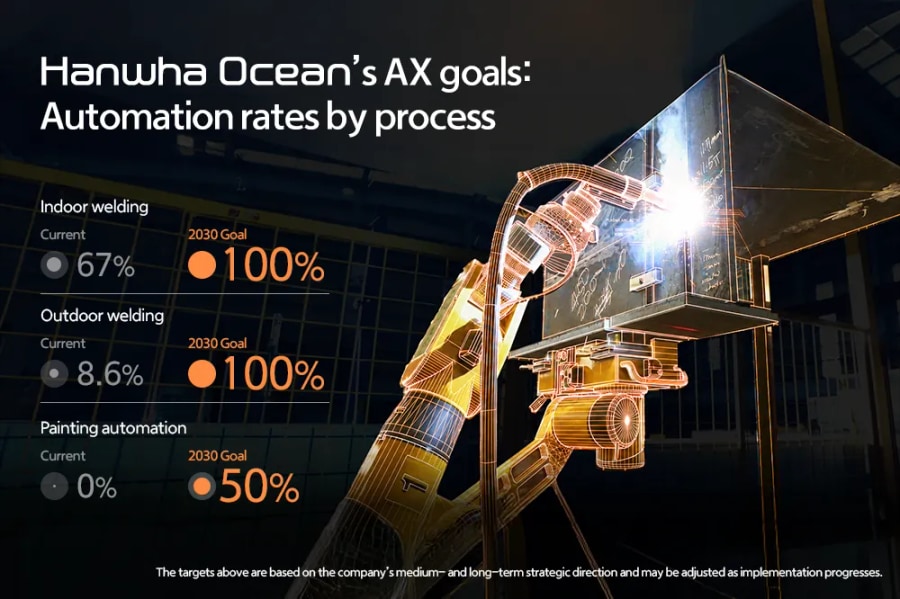
AI currently assists with 67% of indoor welding operations at Geoje. Hanwha Ocean is targeting full welding automation and 50% AI adoption in surface preparation and painting by 2030.
Robots are increasingly handling tasks involving high temperatures, sparks and confined spaces. Workers supervise automated equipment, operate multiple systems and monitor production quality.
The programme also addresses the retention of production knowledge as South Korea’s shipbuilding workforce declines. Shipyards in the country employ about 125,000 people, compared with approximately 200,000 at the industry’s 2014 peak, according to Korea Offshore & Shipbuilding Association figures cited by Hanwha.
Recording working methods as production data allows technical knowledge to be used in automated equipment and management systems beyond an individual workstation.
The technology rollout is taking place as Hanwha develops a $5 billion infrastructure programme for Hanwha Philly Shipyard, announced in August 2025.
The programme includes two additional docks and three quays. Hanwha is also reviewing a new block assembly facility and plans to introduce automation and smart yard systems.
The expansion targets an increase in annual production capacity from fewer than two vessels to as many as 20. Planned production includes LNG carriers, naval modules and blocks, while naval vessel construction remains a longer-term objective.
Workforce training forms part of the cooperation between the two shipyards. Employees from Hanwha Philly Shipyard will receive on-the-job training at Hanwha Ocean’s Geoje facility in connection with LNG carrier construction.
Under the joint-build model, Hanwha Philly Shipyard holds the shipbuilding order and Hanwha Ocean participates in construction. Hanwha said the model would provide a platform for transferring production processes, technical expertise and supplier qualifications to U.S. workers.
The Philadelphia production management platform is targeted for deployment in November 2026, while welding robots developed at Geoje are being introduced during 2026.