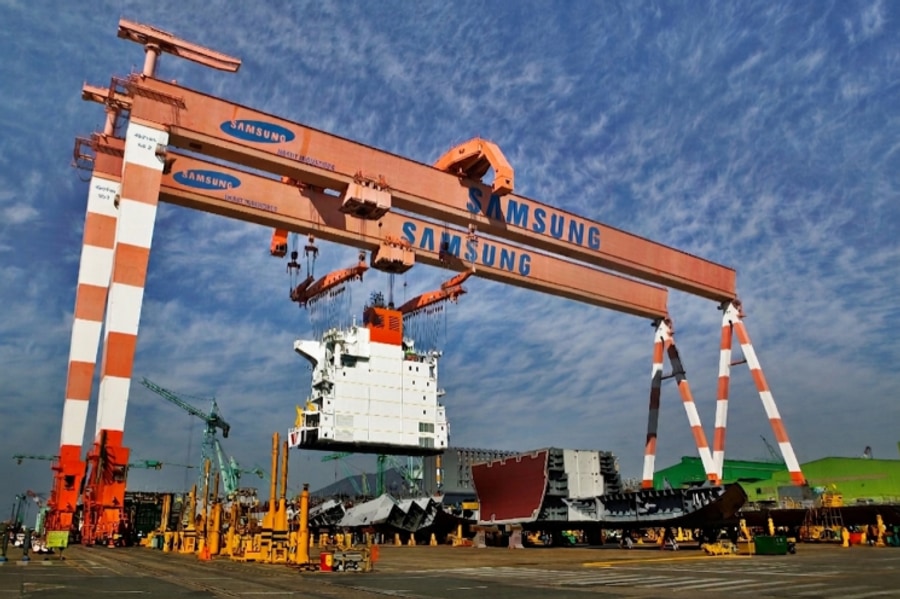
Samsung Heavy Industries is expanding its shipbuilding network in Vietnam as it advances a global operations strategy aimed at balancing production capacity, cost control, and delivery performance.
The company recently completed the process of establishing a local subsidiary in Vietnam. In March 2026, its board-level Management Committee approved the plan to create a new legal entity in the country, after which follow-up procedures were launched. Samsung Heavy Industries said the move was needed to support its global operations strategy in line with local regulations.
Under the strategy, Geoje Shipyard in South Korea is being focused on high-value vessels, including LNG carriers, environmentally friendly container ships, and FLNG units. The yard is also being developed as a technology research and development center.
For more routine orders such as crude oil tankers, Samsung Heavy Industries is using shipyards in China, South Korea, and Southeast Asia. The company remains responsible for newbuilding design, guarantees, equipment, and material procurement.
Vietnam has become a key part of this model. Samsung Heavy Industries said its backlog is now centered mainly on high-value-added vessels, while cooperation with Vietnamese yards is expected to increase total production capacity. The approach is also intended to improve order competitiveness by managing labor and other operating costs more effectively and supporting delivery efficiency.
Between 2024 and 2025, Samsung Heavy Industries outsourced eight Suezmax tankers to PaxOcean Engineering Zhoushan Co., Ltd. (POEZ) in China. As the global operations strategy moves forward, the company is gradually reducing its reliance on Chinese shipyards and shifting more tanker work to Vietnam.
By the end of December 2025, Samsung Heavy Industries had outsourced three Suezmax tankers to PetroVietnam Shipbuilding and Mechanical (PVSM), a subsidiary of Vietnam’s National Industry and Energy Group. During the projects, the company is involved from design and construction through product acceptance and directly supervises technical matters.
The shift toward Vietnamese yards is linked not only to labor costs but also to increased risks for ships built in China under US policy developments. These factors have made Chinese shipyards a less preferred option for outsourcing.
South Korean yards remain part of the outsourcing program. Samsung Heavy Industries has assigned four medium-sized oil tankers to HSG Seongdong Shipbuilding, which has mainly handled hull section work since its bankruptcy restructuring. The contracts are expected to support the yard with stable orders and help accelerate its return to full-ship construction.