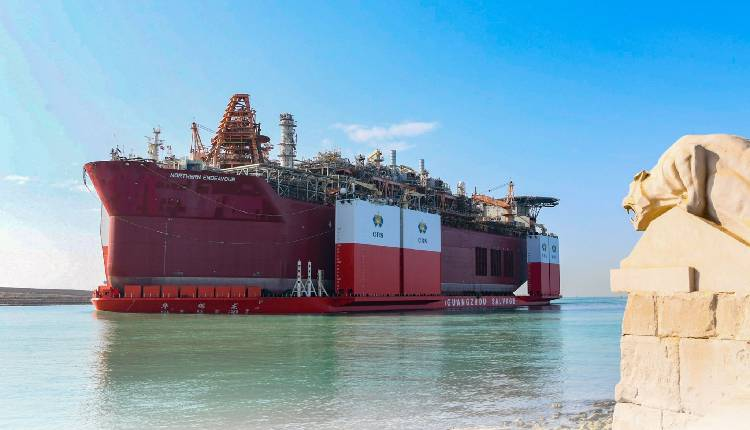
One of the world’s largest semi-submersible heavy-lift vessels, HUA RUI LONG, completed a transit of the Suez Canal on 23 February 2026, moving through the New Suez Canal waterway while transporting the vessel NORTHERN ENDEAVOUR on deck.
The Suez Canal Authority (SCA) confirmed that the vessel had arrived from Singapore en route to Denmark, having passed through the Bab El-Mandeb Strait prior to entering the canal.
According to SCA Chairman Osama Rabie, the operation required special navigational arrangements. With a beam of 77.7 m—exceeding the canal’s standard maximum permitted width of 75 m—the passage was handled under exceptional measures. Four SCA tugboats escorted the vessel, while six senior canal pilots were assigned to oversee navigation from entry to exit. Monitoring was maintained continuously from the main traffic control centre and pilot stations along the route.
Constructed in 2022 and operated by China’s Guangzhou Salvage Bureau, HUA RUI LONG measures 252 m in length, with a draft of 10.5 m and a gross tonnage of 115,254 tonnes. The vessel previously transited the canal in October 2022 during its maiden passage, sailing without cargo.
Rabie stated that the successful execution of this transit demonstrates the canal’s operational capability to accommodate large and non-standard vessels. He added that infrastructure upgrades have strengthened safety margins and expanded capacity, supporting the waterway’s role in handling complex transits.
The southern sector development project has increased navigational safety by 28 percent and widened the canal by 40 m eastward in that section, enabling the passage of vessels previously unable to transit. The New Suez Canal’s straighter alignment and reduced curvature were also cited as factors improving the handling of special movements.
In 2025, the canal received 27 vessels in the same category, with four similar units transiting since the start of 2026. For this voyage, routing via the Suez Canal reduced the distance by 3,432 nautical miles compared with alternative passages, contributing to time, cost and emissions savings.
Source: SIS