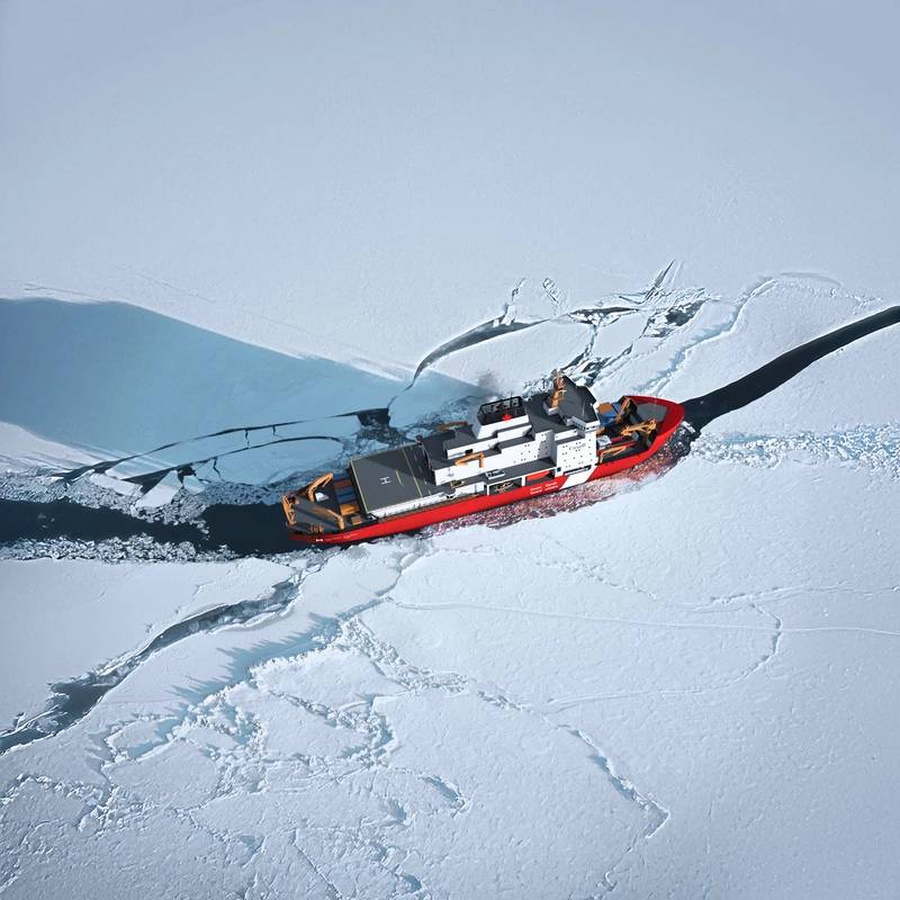
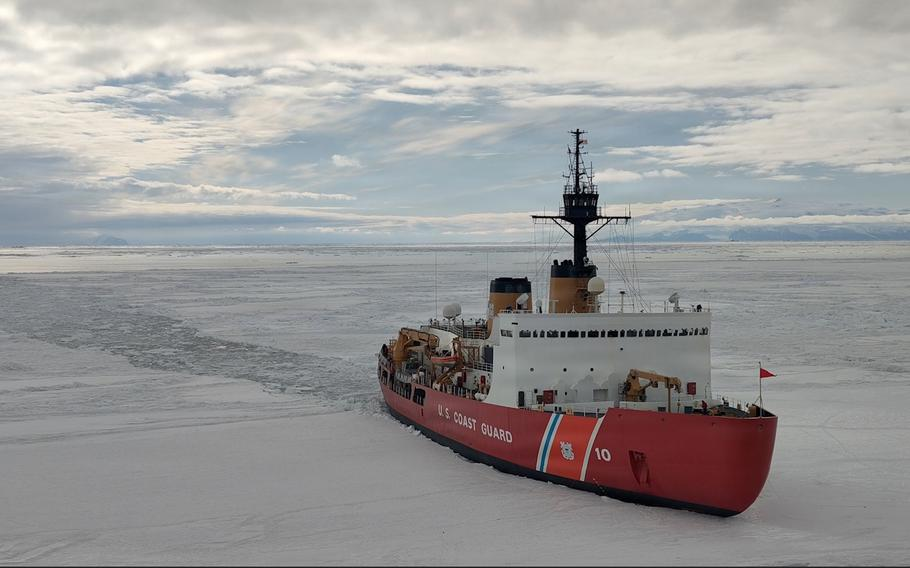
Marking half a century in uniform, the heavy icebreaker Polar Star is spending its 50th year in service doing what it was built to do: cutting through polar ice. Earlier this month, the U.S. Coast Guard cutter reached McMurdo Sound in Antarctica on its annual Operation Deep Freeze deployment, opening channels so supply ships can reach scientific stations near the bottom of the planet.
Service figures indicate that Polar Star can maintain a speed of about 3 knots while working through sea ice roughly 1.8 m (6 ft) thick. By repeatedly backing and then driving forward to ram the pack, the vessel can break ice ridges up to about 6.4 m (21 ft) deep.
The 13,500 t ship entered service on 17 January 1976 and now ranks among only three fully operational U.S. military vessels that are more than 50 years old. The other two are the amphibious command ship USS Blue Ridge, based at United States Fleet Activities Yokosuka in Japan and commissioned in November 1970, and the aircraft carrier USS Nimitz, homeported at Naval Base Kitsap in Washington State and commissioned in April 1975.
Described as the fleet’s “granddaddy”, Polar Star departed its home port at Coast Guard Base Seattle on 20 November to begin the current Antarctic mission.
Before sailing from Seattle, commanding officer Capt. Jeff Rasnake said in an interview that he hoped to mark the ship’s 50th “birthday” near Cape Polar Star, a headland on the southwest tip of Coulman Island in Antarctica’s Ross Sea that took the icebreaker’s name in the 1980s. He added that, if conditions allow, the crew plans to celebrate the anniversary in those waters and characterized the vessel as old but dependable.
The U.S. government operates only three oceangoing icebreakers, and Polar Star is one of them. In addition, the Coast Guard deploys two medium icebreakers, USCGC Healy and USCGC Storis, which are rated to break ice up to about 2.4 m (8 ft) thick using a similar ramming method.
In the 1970s, the Coast Guard commissioned two heavy icebreakers: Polar Star in 1976 and its sister ship Polar Sea in 1978. Polar Sea was withdrawn from service in 2010 because of severe engine wear, leaving Polar Star as the service’s sole heavy icebreaker.
The cutter carries the Latin motto “Naviget Bene Turbatum Mare”, a phrase expressing the hope that the ship will sail safely through rough seas.