Japan has moved from debating whether to back its shipyards to actively rebuilding them, treating shipbuilding as a core element of industrial policy, economic security and maritime strategy ahead of 2035. For the wider shipping market, this renewed commitment signals a structural shift that adds a geopolitical dimension, reinforces global shipping networks and helps Japan act as a durable counterbalance in a shipbuilding market that is becoming more concentrated worldwide.
The financial backbone of this agenda was laid toward the end of 2025, when the government approved an additional budget that earmarked ¥120 billion specifically for shipbuilding revitalisation within a broader 10-year package of ¥350 billion. The plan’s central objective is to lift domestic capacity for ocean-going commercial tonnage to 18 million gross tonnes a year by 2035, effectively doubling today’s output.
Policy momentum strengthened as trade tensions with the United States intensified and shipbuilding cooperation entered the bilateral agenda. In May, then-prime minister Shigeru Ishiba visited JAPAN MARINE UNITED CORPORATION’s Maizuru Shipyard in Kyoto Prefecture after inspecting a Japan Maritime Self-Defense Force base. Shortly afterwards, the government released its “Basic Policy on Economic and Fiscal Management and Reform 2025,” which explicitly highlighted the rebuilding of shipbuilding and the reinforcement of Japan’s broader maritime cluster.
Within the ruling Liberal Democratic Party, the Special Committee on Marine Transportation and Shipbuilding added further political weight. It submitted an urgent recommendation calling for expanded production of both commercial and naval vessels and proposed that ship hulls be designated as “critical materials” under the Economic Security Promotion Act.
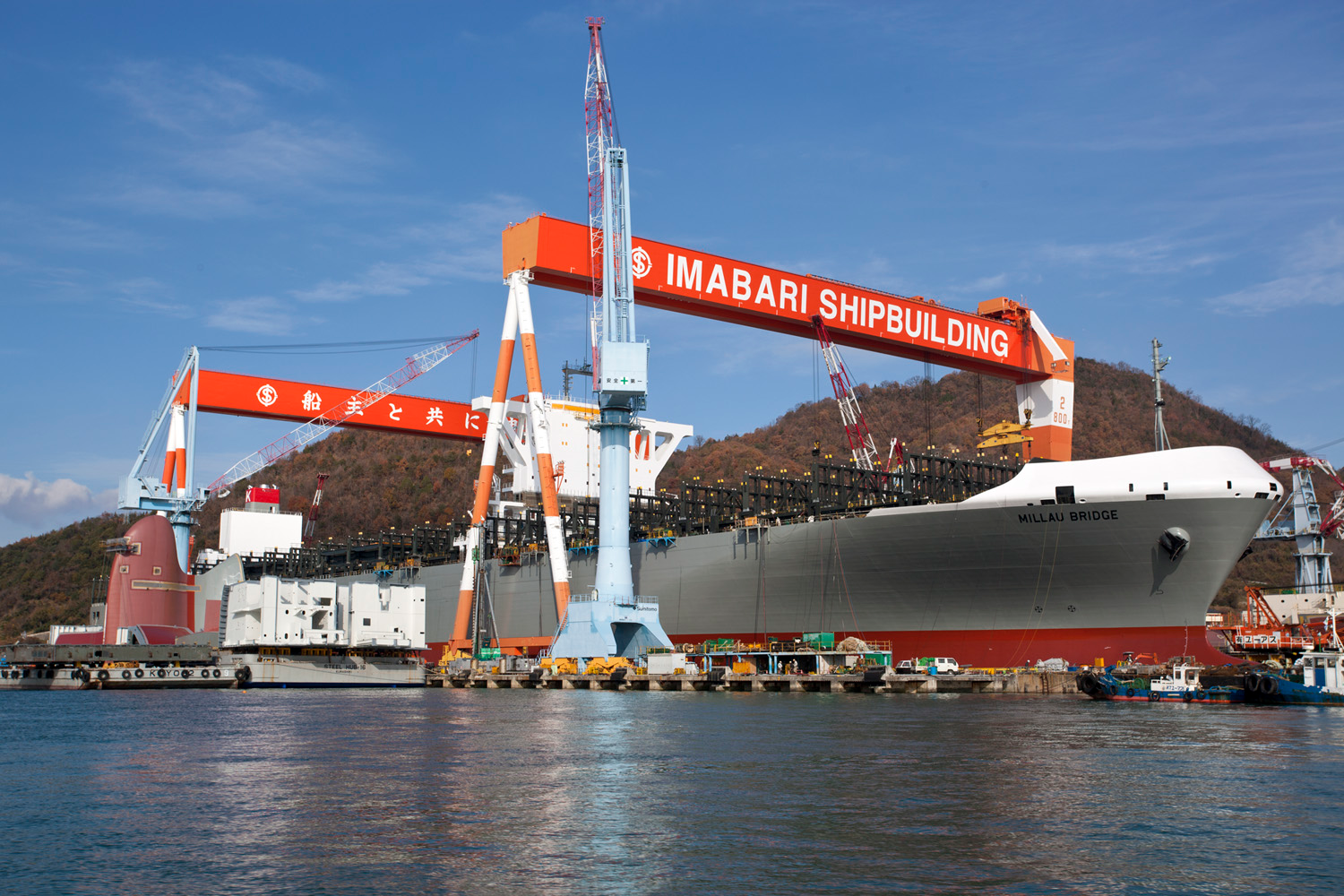
Industry organisations responded quickly. Shipbuilders’ Association of Japan (SAJ) chairman Yukito Higaki, who is also president of Imabari Shipbuilding Co Ltd, set a target of lifting Japan’s global share of the newbuilding market to 20%, in line with the 18 million gross tonne capacity goal.
In October, SAJ, THE JAPANESE SHIPOWNERS’ ASSOCIATION (JSA), The Cooperative Association of Japan Shipbuilders (CAJS), and the Japan Ship Machinery & Equipment Association (JSMEA) jointly called for large-scale financial support, tax incentives for capital investment, and a clear national roadmap for the sector.
That same month, Japan and the United States signed a memorandum on cooperation in shipbuilding. Japan’s Minister of Land Yasushi Kaneko and U.S. Commerce Secretary Howard W. Lutnick agreed to create a bilateral working group focused on capacity expansion and industrial collaboration.
Shipbuilding’s elevated status was underscored at a national growth strategy meeting, where Japanese Shipowners’ Association chairman Hitoshi Nagasawa and SAJ chairman Higaki stressed that the sector has been moved into the top tier of Japan’s strategic industries.
Taken together, long-term public funding, party-level backing, coordinated industry advocacy and closer ties with the United States show that Japan has decisively chosen to rebuild its shipbuilding base—not only to support domestic yards, but also to reshape global shipping networks through 2035.