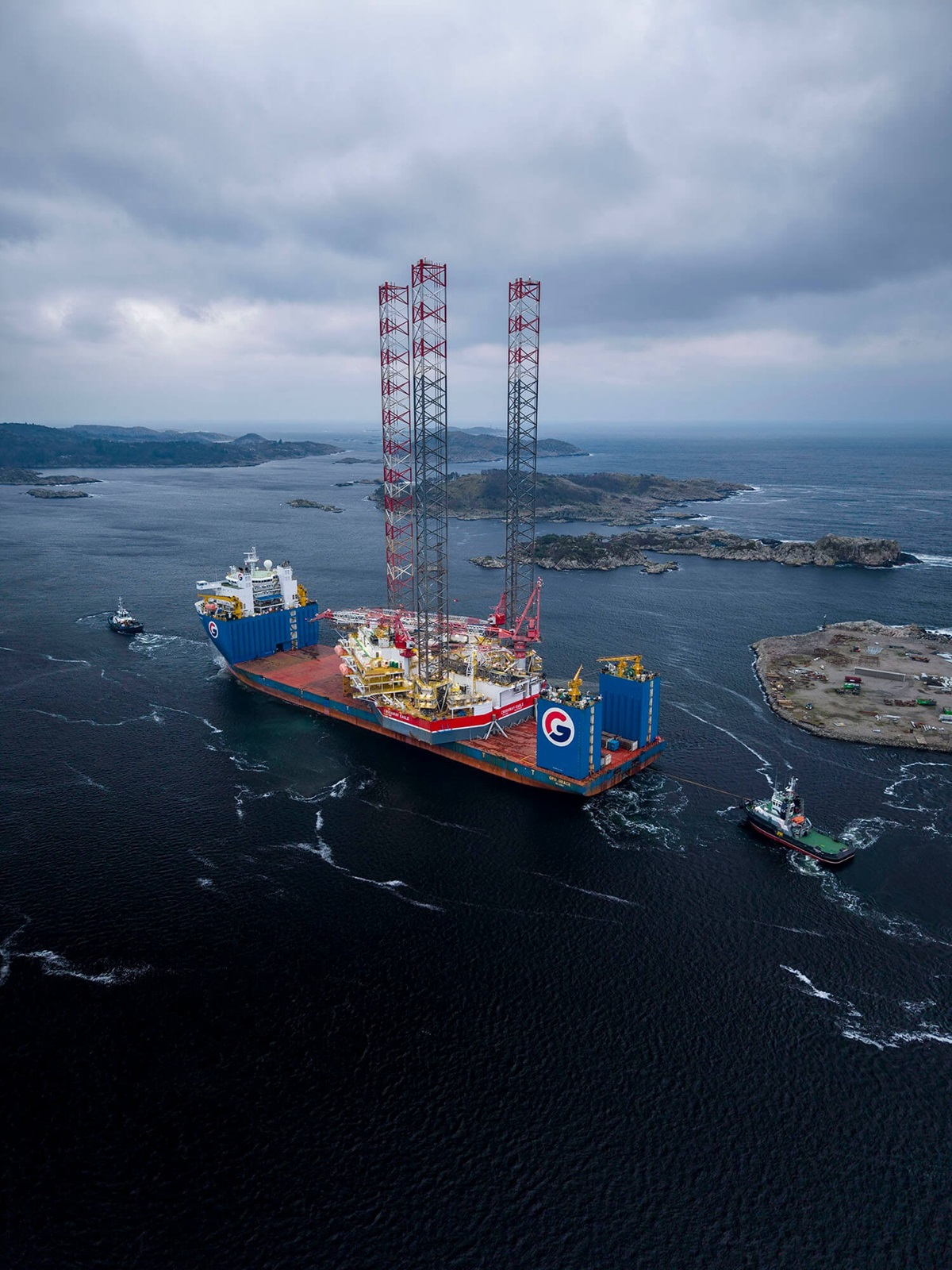
Klevefjorden – When the 225 m heavy-lift vessel GPO Grace entered Klevefjorden to load Macro Offshore’s accommodation rig Crossway Eagle, it marked the largest ship operation ever carried out in this section of the port. The operation shows how harbour facilities, fairways and maritime competence together enable complex, high-value projects in the Lindesnes region.
GPO Grace is one of only a few vessels worldwide with this type of capacity. The ship is 225 m long and 48 m wide, and can be ballasted so that the top of the deck lies up to 15 m below the waterline. The deck is rated for loads of 30 t/m², making the vessel particularly suitable for transporting large offshore installations.
In Klevefjorden, Crossway Eagle was towed over GPO Grace after the deck had been lowered about 8 m below the surface. The rig was then raised and secured on board in a float-on operation, where Pentagon Marine AS played a central role. This was followed by three days of extensive sea fastening before GPO Grace set course for New York, where the rig is to be floated off again.
“On its own, the float-on operation in Mandal has an estimated value of between three and four million kroner. Most of that goes to key players such as Kystverket, Farmar and the port, but smaller suppliers, transport services and local purchases also benefit. It clearly shows how operations like this create ripple effects far beyond the main assignment itself,” says Kirsti Dvergsnes of Pentagon Marine AS.
The working atmosphere during the project was characterised by a shared mindset, summed up during the operation as follows: “Whatever we may lack in experience with this type of operation, we make up for with a positive attitude and a clear ‘yes we can’ approach. That shaped the cooperation and was shared by everyone involved in the operation.”
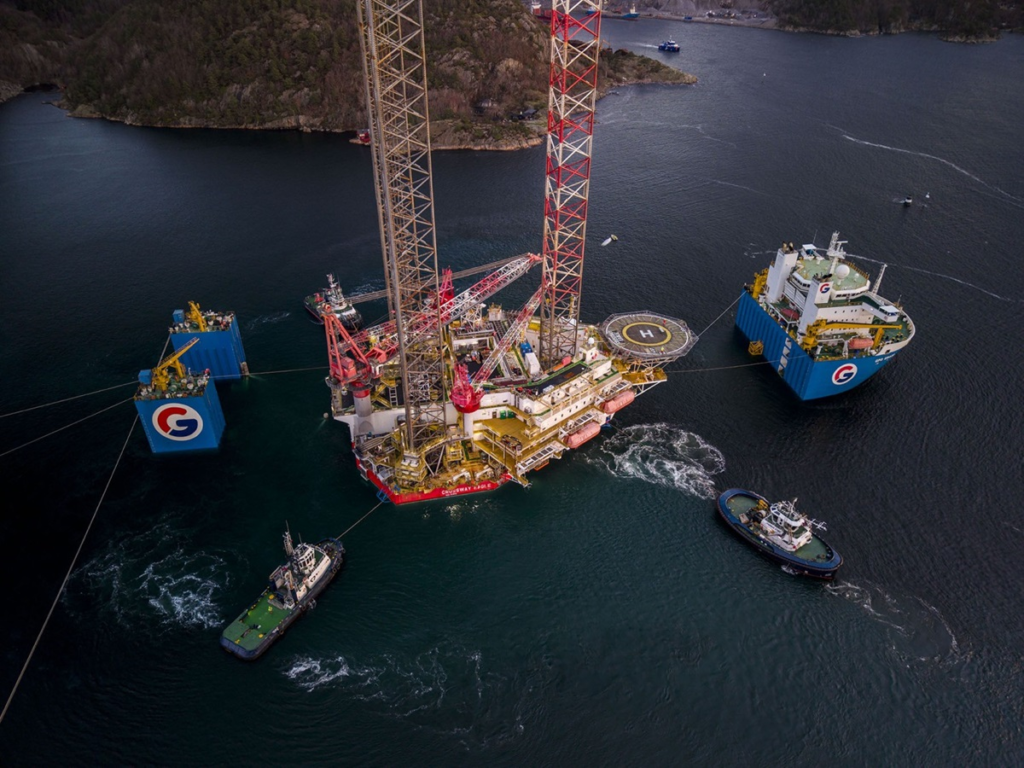
The rig already has a 6+4-year offshore wind contract with Siemens Energy, underlining a shift from oil and gas-related work towards renewable energy. That a transport of this scale can be handled in the Lindesnes region is due to several local conditions: sheltered waters and stable conditions in Klevefjorden, a short and efficient approach, ample space for manoeuvring and temporary securing, and close coordination between the port, pilots, tugboats and operators.
Kristiansand Havn IKS supported the operation with port expertise, local personnel and a workboat, working closely with pilots and other maritime stakeholders.
Maintenance and classification work on Crossway Eagle has been carried out at Windport on Gismerøya in Mandal, where GOT Vinje Industri AS was responsible for a comprehensive 10-year SPS (Structural Periodic Survey). The classification was completed using a method that differs clearly from traditional solutions. For the first time, the rig was jacked up with the help of large barges so that each leg could be inspected individually.
“What has also been done for the first time is to jack up the rig with barges so we could inspect the legs themselves. We can do that because we have a sheltered harbour and, not least, a very small tidal range on Sørlandet. That means we can carry out drydock activities without a drydock,” says Turid Storhaug, managing director of Windport.
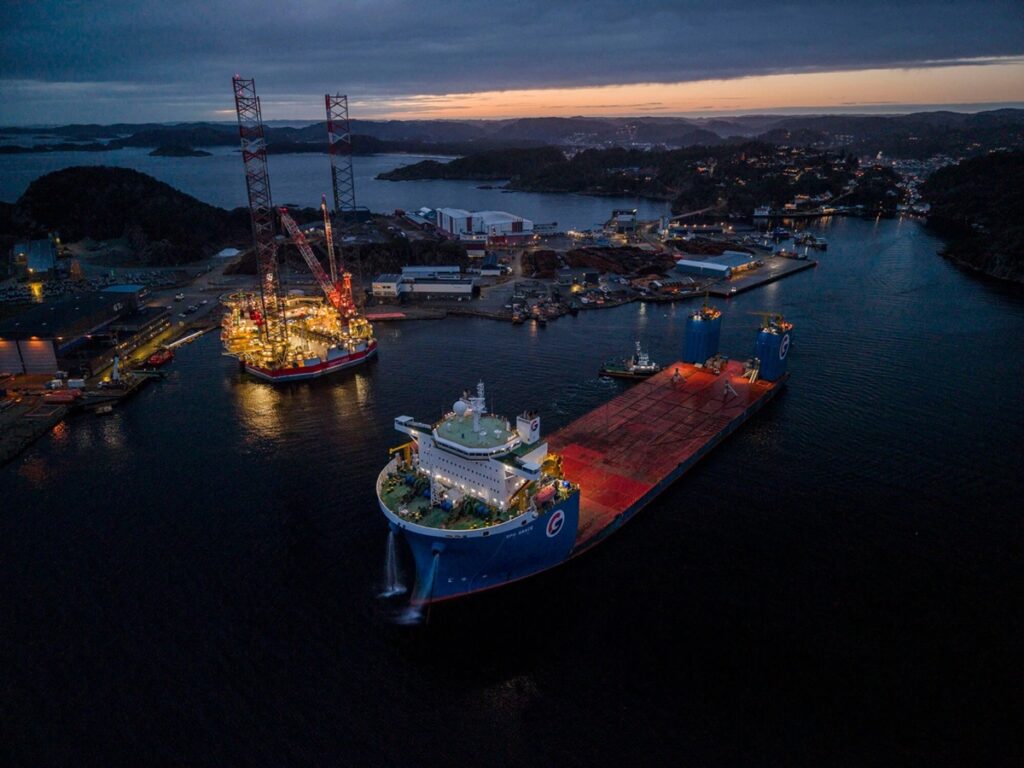
The prepared seabed at Windport on Gismerøya allowed the rig to stand safely on two legs while the weight was transferred to a large barge positioned under the rig. GOT Vinje Industri AS performed the 10-year classification for ABS as a subcontractor to Windport.
In addition to the classification work, maintenance and upgrade activities worth many tens of millions of kroner have been carried out, involving several dozen local and regional companies. On average, more than 100 workers have taken part in the project while the rig has been alongside for a little over two months.
Source: Port of Kristiansand IKS