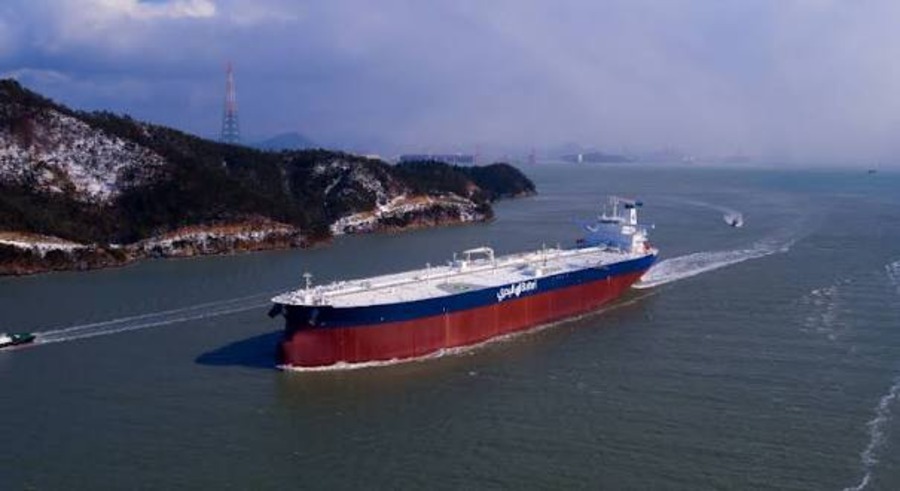
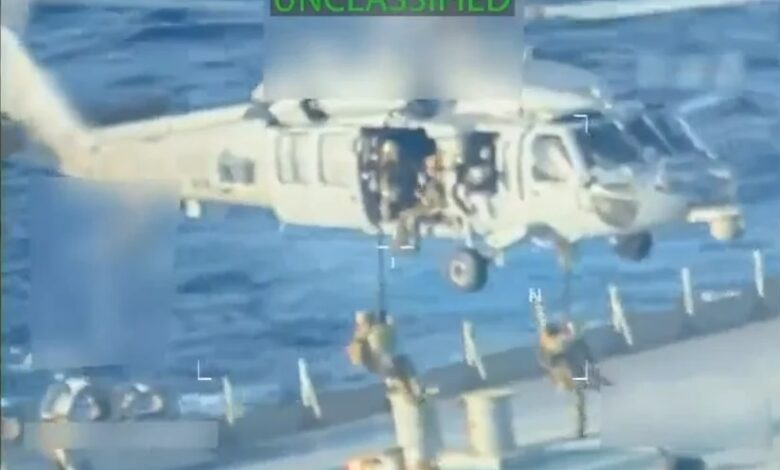
US forces have taken control of a very large crude carrier off Venezuela that many analysts regard as the VLCC Skipper, after satellite imagery showed the 310,000 dwt tanker quietly taking on about 1.1 million barrels of Venezuelan Merey crude subject to sanctions at the Jose export terminal while it was transmitting falsified AIS positions.
The Trump administration confirmed the operation on Wednesday, saying only that the target was a very large tanker and the biggest vessel it had ever seized. Maritime intelligence firms including Vanguard and Kpler have pointed to the ship as the Skipper, a vessel long linked to sanctions-evading oil movements involving Venezuela, Iran and Asia. The tanker, which previously traded as Adisa, is operating under a fraudulent Guyanese flag.
The boarding follows several weeks of US military reinforcement in the Caribbean, including the deployment of an aircraft carrier, fighter jets and tens of thousands of troops, as Washington moves to clamp down on dark-fleet logistics that support Caracas and Tehran. In November, Venezuela’s crude exports were running at about 700,000 barrels a day.
Data compiled by Kpler show the Skipper alongside at Jose on 14 November, in contrast to AIS signals that placed the ship near the Liza Destiny and Liza Unity FPSOs off Guyana. Market reports indicate the tanker loaded roughly 1.1 million barrels of Merey on 16 November, with Cuba listed as the destination and Cubametales as charterer.
Today, the Federal Bureau of Investigation, Homeland Security Investigations, and the United States Coast Guard, with support from the Department of War, executed a seizure warrant for a crude oil tanker used to transport sanctioned oil from Venezuela and Iran. For multiple… pic.twitter.com/dNr0oAGl5x
— Attorney General Pamela Bondi (@AGPamBondi) December 10, 2025
The tanker has repeatedly been associated with falsified AIS tracks, misdeclared cargoes and deceptive ship-to-ship operations. In July, the Skipper broadcast a track suggesting a call at Iraq’s Basrah oil terminal, but satellite imagery reviewed by Kpler instead showed the vessel at Iran’s Kharg Island loading crude while sending spoofed coordinates. After sailing east, it carried out an STS transfer with the VLCC Luois off Hong Kong in August; that cargo was later discharged in China under documents that incorrectly described the oil as Angolan Girassol.
After returning to Iranian waters, the tanker turned west, passed the Cape of Good Hope and reappeared off Guyana and Suriname in late October — a route typical of dark-fleet operations designed to conceal the true origin of shipments.
The US has not disclosed where the seized vessel is now being held or the status of its crew. Even so, the capture represents one of Washington’s most notable recent enforcement steps against the shadow fleet and adds to uncertainty over Venezuela’s ability to maintain its crude export flows.
Venezuela’s government has denounced the US action against the VLCC off its coast as “blatant theft” and “an act of international piracy.” Interior minister Diosdado Cabello went further, calling US authorities “murderers, thieves, [and] pirates.” Caracas said it will take the case to international bodies and has pledged to formally denounce the seizure on the global stage.