
An investigative report released in early December 2025 reveals how drug cartels have adopted a shocking method to smuggle cocaine into Europe — by hiding narcotics aboard livestock ships carrying thousands of disease‑ridden cows.
Cattle Carriers as Smuggling Havens
Criminal syndicates load up to 10,000 cows onto aging 200‑meter livestock vessels departing from cartel‑controlled ports such as Santos and Belém in Brazil, and Cartagena in Colombia.
Once at sea, these ships serve as floating hubs for cocaine hidden inside massive grain silos or other concealed compartments. With the cows often sick, dying, or already dead, the resulting stench and decomposing waste make boarding or inspecting the ships nearly impossible for authorities.
Smuggling Route and Concealment Method
Although the vessels officially list destinations such as Beirut (Lebanon) or Damietta (Egypt) — where livestock import rules are more lenient — the real goal is smuggling cocaine into key European ports like Antwerp or Rotterdam.
At some point during the Atlantic crossing, crews attach cocaine packages to inflatable devices equipped with GPS trackers and jettison them into the sea. Fast “go‑fast” boats then retrieve the floats and transport the drugs ashore stealthily.
Enforcement Challenges and Rare Busts
Authorities describe boarding these vessels as a “logistical nightmare”: the smell, presence of thousands of distressed animals, and the effort required to unload livestock before inspection all act as strong deterrents.
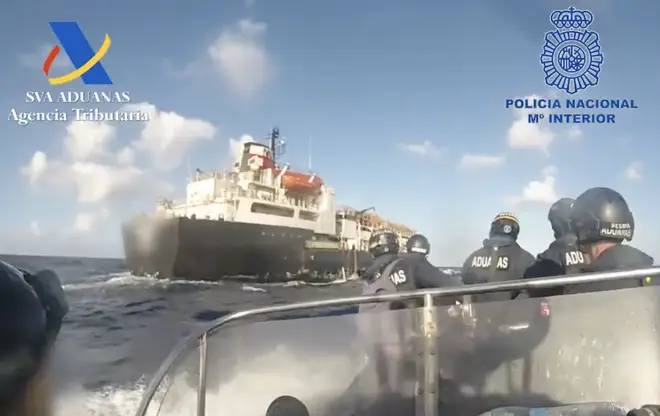
Over the past 18 years, only a single livestock ship has been intercepted carrying cocaine. That was on January 24, 2023, when Spanish forces seized the 100‑meter vessel Orion V, 62 nautical miles southwest of the Canary Islands. On board were 1,750 cows and 4,500 kg of cocaine — estimated to be worth around £82 million — hidden in feed silos. Officers had to wade through piles of dung and urine to reach the contraband.
Growing Alarm Among Maritime and Law Enforcement Agencies
According to the EU‑based Maritime Analysis and Operations Centre – Narcotics (MAOC‑N), such livestock‑ship smuggling is becoming more frequent. Many vessels are flagged under countries with lax maritime regulations (e.g. Panama or Tanzania), giving traffickers a legal shield.
Authorities point out that without precise intelligence about the drugs’ location on board, executing a seizure operation would require considerable resources. As one MAOC‑N analyst remarked: “You can only imagine the smell… the countries don’t want to do inspections on board these vessels.”
Implications for Maritime Security and Drug Enforcement
The emergence of “cocaine cows” as a smuggling tactic marks a troubling shift in maritime drug trafficking — exploiting humanitarian regulations and the difficulty of inspecting livestock carriers. Traditional detection tools (e.g. sniffer dogs) are rendered ineffective by the stench and chaos on board.
For Europe’s port authorities and international agencies such as MAOC‑N, this tactic presents a multidimensional challenge: balancing animal‑welfare protocols, biosecurity laws, and the imperative to enforce drug control. Unless new inspection strategies are developed — perhaps combining targeted intelligence, remote sensing, or enhanced cooperation between port states — many such shipments may continue to slip through.