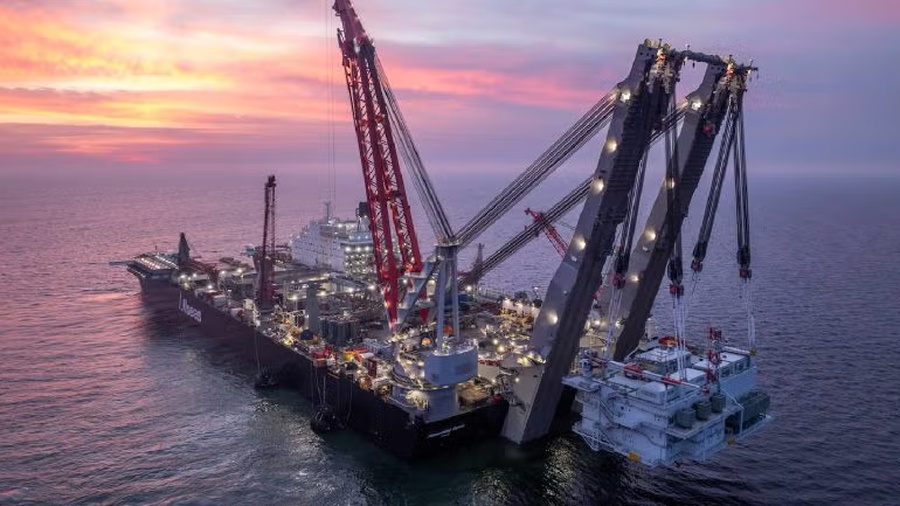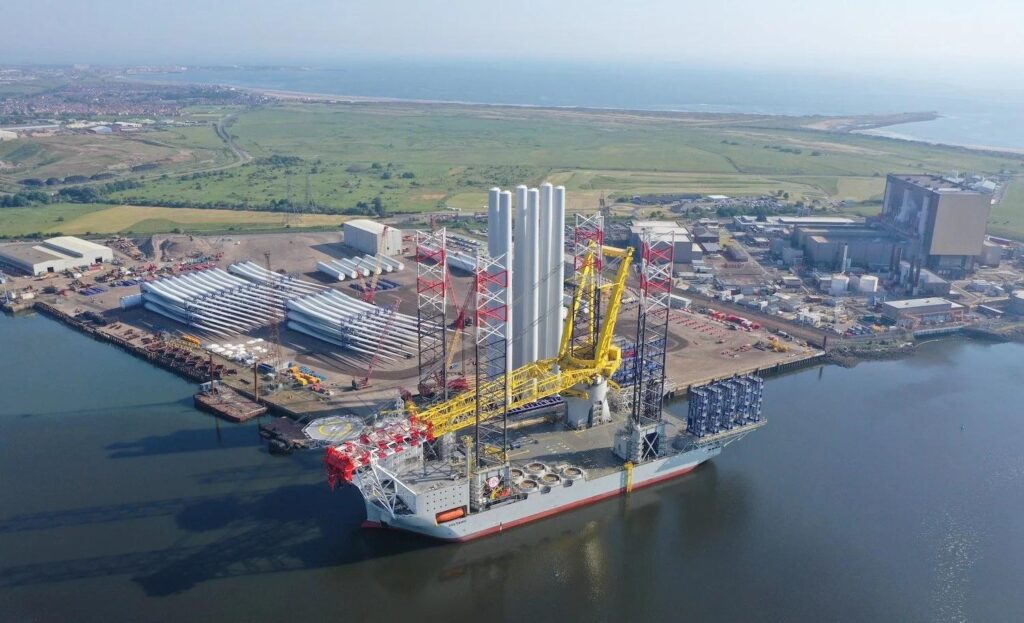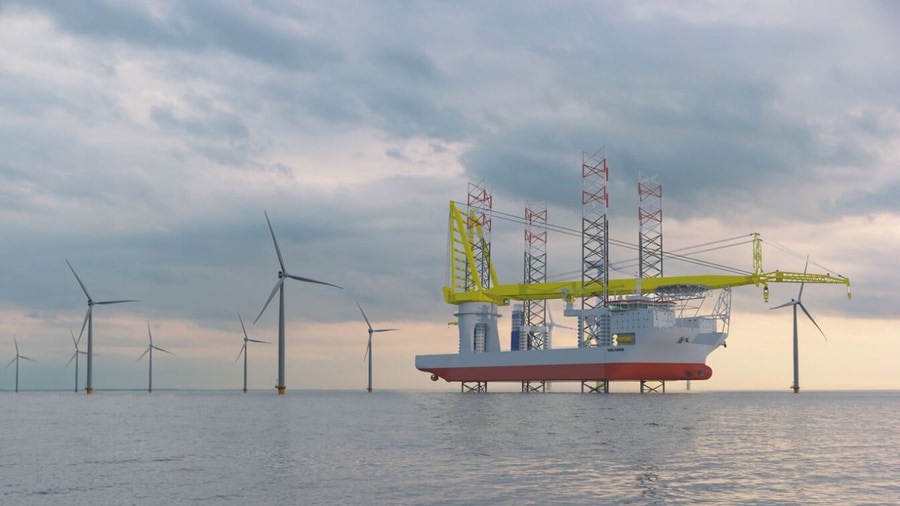
Mammoet has completed a series of heavy transports and vessel transfers for the three offshore substations serving the Dogger Bank Wind Farm in the North Sea. This involved supporting Aibel across its yards in Thailand and Norway.
Once fully operational, the Dogger Bank A, B, and C phases, led by SSE Renewables, Equinor, and Vårgrønn, will together form the world’s largest offshore wind farm, with an installed capacity of 3.6GW, supplying electricity to around six million homes annually in the UK. The substations, fabricated by Aibel, are essential for transmitting power, collecting energy from hundreds of turbines, converting it, and sending it ashore.
The fabrication of the topsides was split between Aibel’s yard in Thailand and its facility in Haugesund, Norway. This division required meticulous coordination of engineering teams, transport equipment, and a dedicated heavy-lift vessel to ensure that each phase — load-out, sea transport, and final dispatch to the North Sea — was completed on schedule.
To support the three substations, Mammoet drew on one of its largest recent deployments of SPMTs, mobilizing 682 axle lines from its global fleet. In Laem Chabang, Thailand, 338 axle lines were used to perform the initial load-outs, moving the topsides when they weighed about 7,500t. After a 45–50 day sea passage, 344 axle lines were mobilized in Norway: 264 for the load-in operation, and 80 for the final weighing and load-outs once the additional transformers and equipment increased each unit’s mass to approximately 9,350t. These axle lines were shipped and trucked in from various locations and configured on-site for each phase.
In Thailand, each topside was transported roughly 1,000m over public roads from Aibel’s fabrication yard to the port. Fences were removed, and a temporary gravel ramp was constructed so that the SPMT convoys could bypass the main entrance. Inside the terminal, the substations were rolled onto heavy-load carriers using RoRo ramps. After being lifted with their hydraulic stroke, the SPMTs positioned the structures on the vessel grillage, then rolled off with the interface beams and a dedicated load-out frame.
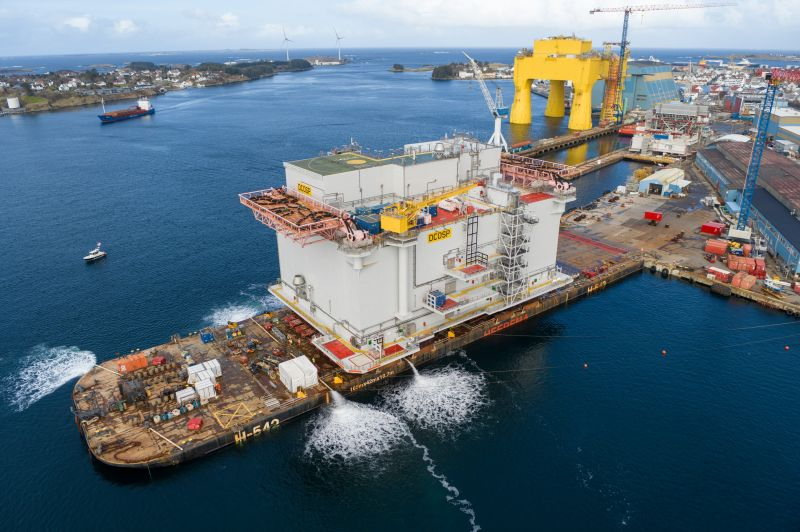
Upon arriving in Haugesund, the substations were driven off the vessel using 264 axle lines, taking advantage of the higher allowable ground-bearing pressure at the Norwegian quay. The units were transferred onto temporary supports near the waterside for completion of steelwork, installation of transformers, and integration of other complex systems. Aibel fabricated two custom load-out frames that securely held the substations on the trailers; one of these frames traveled with the Dogger Bank A substation from Thailand and remained in service for all three units’ load-ins and load-outs.
Before the final dispatch to the offshore site, each completed substation underwent a detailed weighing procedure. Using 36 jacks and load cells per topside, Mammoet repeated the weighing process three times to ensure the accuracy of the final weight and center of gravity, which were essential for marine transport and installation. Engineers from Aibel and Mammoet designed custom grillage beams to channel the loads through the strongest structural points of the topsides during lifting and jacking.
For the final load-out from Norway to the North Sea, 344 axle lines of SPMTs were mobilized to accommodate the increased weight of the substations after the installation of electrical equipment. Mammoet managed barge ballasting with 16 submersible pumps, each rated at 1,000m³ per hour, to maintain the vessel’s stability during the load transfer from the quayside to the barge.
Since the same logistical sequence was repeated for Dogger Bank A, B, and C over a span of approximately three years, the project teams refined their methods between each phase. By the time the Dogger Bank C substation was ready to depart from Thailand, the load-out process was reduced by a full day compared with earlier operations. According to Mammoet, the ability to quickly adapt to any changes in the project plan — through close collaboration between engineering, project management, and planning teams — was key to the project’s success.
With these heavy-lift transports and vessel transfers now complete, the substation scope for Mammoet and Aibel marks a major milestone in the journey toward the full 3.6GW operation of the Dogger Bank Wind Farm and its contribution to the UK’s renewable energy supply.