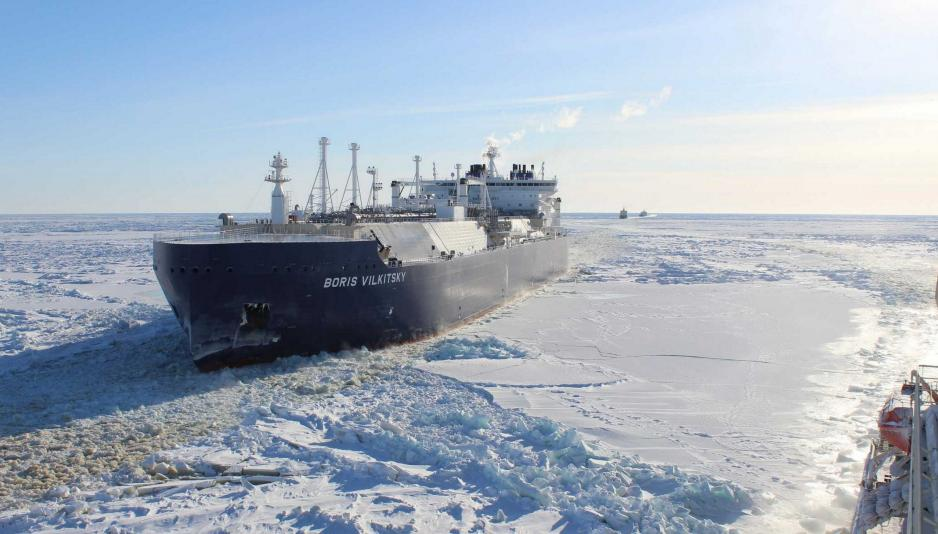
Russia is wrapping up this year’s operations on the Northern Sea Route (NSR) as winter ice begins to rebuild across the Arctic. The seasonal corridor, usually open from June through November, started its 2025 navigation period with the Georgiy Ushakov on 20 June. The final LNG cargo of the season is now en route aboard the Boris Vilkitsky, after which Novatek will redirect winter exports toward Europe.
Over the summer and autumn, Novatek delivered nearly 3 million tonnes of LNG to Asia from its Yamal LNG and Arctic LNG 2 projects, with China taking the majority of the volumes. Output from Yamal LNG fell 18% year-over-year following maintenance on one production line, resulting in 1.96 million tonnes shipped on 28 cargoes. At least 20 of these deliveries went to China, about 500,000 tonnes below the 35 shipments sent during the previous season.
Arctic LNG 2 contributed 14 shipments totaling 840,000 tonnes. After the U.S. sanctioned the project in September 2023 and Novatek struggled to place its cargoes last year, flows resumed when China designated the Beihai terminal in Guangxi as a ring-fenced facility to shield operations from potential Western actions. Beihai has since taken 14 shipments, including volumes stored for months aboard LNG carriers and two FSUs. The UK has now sanctioned the terminal, while the U.S. and EU have not.
Logistics in the region continue to hinge on vessel availability. Yamal LNG operates a fleet of fourteen Arc7 ice-class carriers, though the Christophe de Margerie shifted to Arctic LNG 2 after sanctions targeted the vessel. Arctic LNG 2, by contrast, relies heavily on a shadow fleet with changing ownership and uncertain insurance. The project employed 10 carriers in 2025 across multiple ice classes. With only one high ice-class ship—the Christophe de Margerie—exports are expected to remain constrained for the next eight months.
Russia’s shortage of ice-capable vessels persists. The Zvezda shipyard near Vladivostok has delivered only a single Arctic-ready vessel in recent years: the 69,000 dwt Arc6 shuttle tanker Valentin Pikul. Limited ship availability and challenging ice conditions along the eastern NSR—including the western Laptev Sea and eastern East Siberian Sea—contributed to a 4.2% decline in crude movements this summer, falling to about 1.83 million tonnes, again with China as the primary customer.
Arctic trade patterns are expected to shift from 2026, as the EU’s 19th sanctions package phases out Russian gas imports. Short-term contracts will end by mid-2026, with a complete ban taking effect on 1 January 2027. Russia is increasingly turning to ship-to-ship (STS) transfers to maintain export flows. In a recent operation, the Hong Kong-registered CCH Gas participated in the first dark-vessel LNG STS, taking roughly 97,000 tonnes of LNG from Perle near Malaysia. The cargo has not yet been discharged, though industry observers indicate it may ultimately head to Beihai.
Source: gCaptain