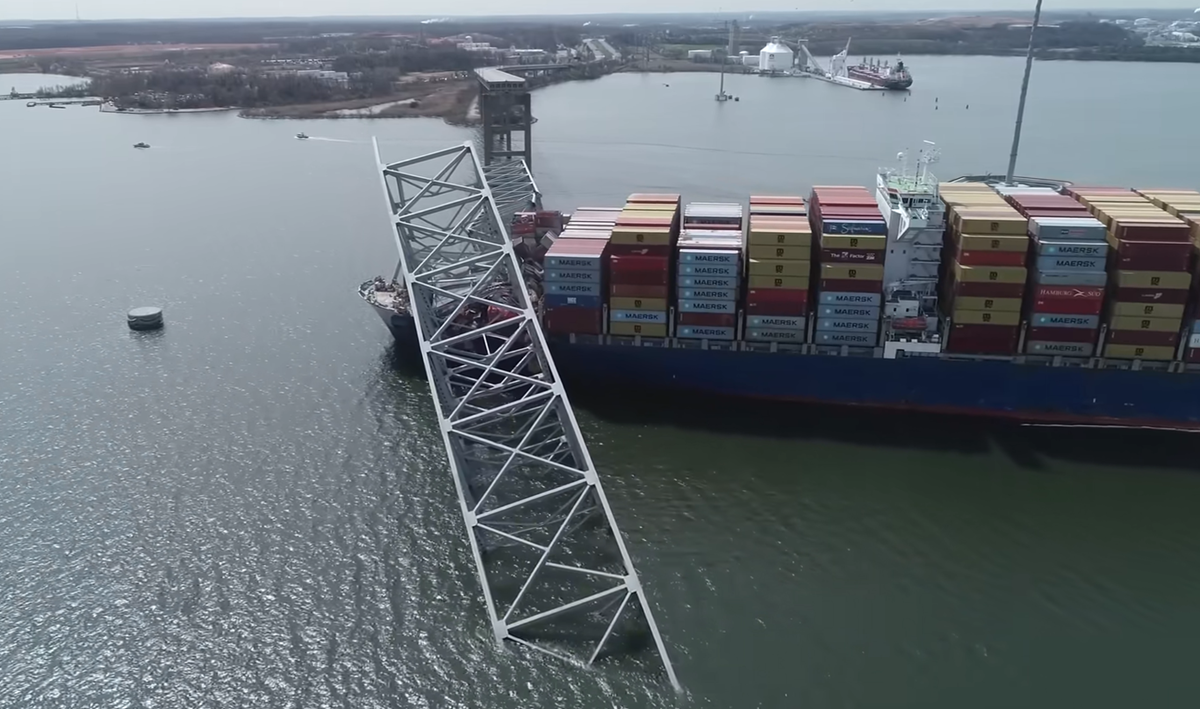
The National Transportation Safety Board (NTSB) has determined that the 26 March 2024 collapse of Baltimore’s Francis Scott Key Bridge began with a signal wire that was not fully inserted into its terminal block spring-clamp gate due to improperly installed label banding. The loose connection caused a high-voltage breaker to open, resulting in a blackout aboard the 984-ft containership Dali as it departed Baltimore Harbor.
Power was lost at approximately 0129 local time, disabling steering-gear pumps, the fuel-oil flushing pump and the main-engine cooling-water pumps. With propulsion unavailable, the vessel drifted starboard toward Pier 17, and efforts by the pilots and bridge team to adjust the heading could not alter the ship’s movement. The impact with the southern pier supporting the central span led to the collapse of major truss, deck and pier components into the Patapsco River, with debris falling onto the forward areas of the vessel.
Six members of a seven-person road-maintenance crew died, while one worker survived with serious injuries. An inspector on the bridge was uninjured. One of the 23 people aboard the Dali sustained a minor injury.
The NTSB concluded that the blackout, caused by the improperly seated wire, was the probable cause of the accident. Contributing factors included the absence of countermeasures designed to reduce the bridge’s susceptibility to collapse from vessel impact and the lack of immediate communication instructing workers to evacuate the span.
The investigation also identified several technical concerns. The ship’s main engine was configured to shut down when cooling-water pressure dropped—consistent with standards at the time of construction—yet the arrangement left the vessel without propulsion when the cooling-water pump lost power. The flushing pump being used to supply the diesel generators did not include redundancy, and the NTSB stated that infrared thermal imaging, if used during preventative maintenance, could have detected the loose wire. The Board noted that the Key Bridge, opened in 1977, was exposed to vessels that had become “substantially larger” than those in service when it opened, including the Dali, which was ten times the length of the Blue Nagoya, a ship that made contact with the same bridge in 1980.
During the investigation, the NTSB contacted 30 bridge owners across the United States, urging them to evaluate strike vulnerability using AASHTO criteria, calculate collapse-risk probabilities and consider countermeasures such as fendering, structural upgrades, motorist-warning systems and traffic-control approaches. The Board also credited quick actions by the pilots, dispatchers and the Maryland Transportation Authority for stopping traffic before impact.
Damage to the Dali exceeded $18 million, while replacing the bridge is estimated to cost $4.3–$5.2 billion, with completion expected in late 2030. More than 34,000 vehicles, including all hazardous-materials traffic restricted from Baltimore’s tunnels, must now use extended detours.
The vessel’s owner, Grace Ocean, and manager, Synergy Marine Group, stated they would examine the Board’s findings. Eight crewmembers remained in the United States during the investigation, with four granted permission to visit their families in early December.
The NTSB issued 18 new safety recommendations to a range of organizations, including the U.S. Coast Guard, ClassNK, ANSI, the ANSI A10 Committee, the Harbor Safety Committee National Steering Team, HD Hyundai Heavy Industries, Synergy Marine Group, WAGO Corporation, multiple bridge owners (including Caltrans, MDTA and TxDOT), AASHTO, and the Federal Highway Administration (FHWA). These recommendations address subjects such as redundancy for large ships, improvements to safety-management systems, voyage-data-recorder standards, emergency-communication protocols, electrical-maintenance practices, labeling procedures, terminal-block documentation and bridge-protection requirements.
The NTSB also reaffirmed four urgent recommendations issued in March 2025, which focus on vessel-collision-risk assessments and coordination among federal agencies and bridge owners. A summary of the findings and recommendations is available through the NTSB, with the full report scheduled for release in the coming weeks.