Search
Close this search box

Russian Ship Spotted Near Oahu, Coast Guard Responds

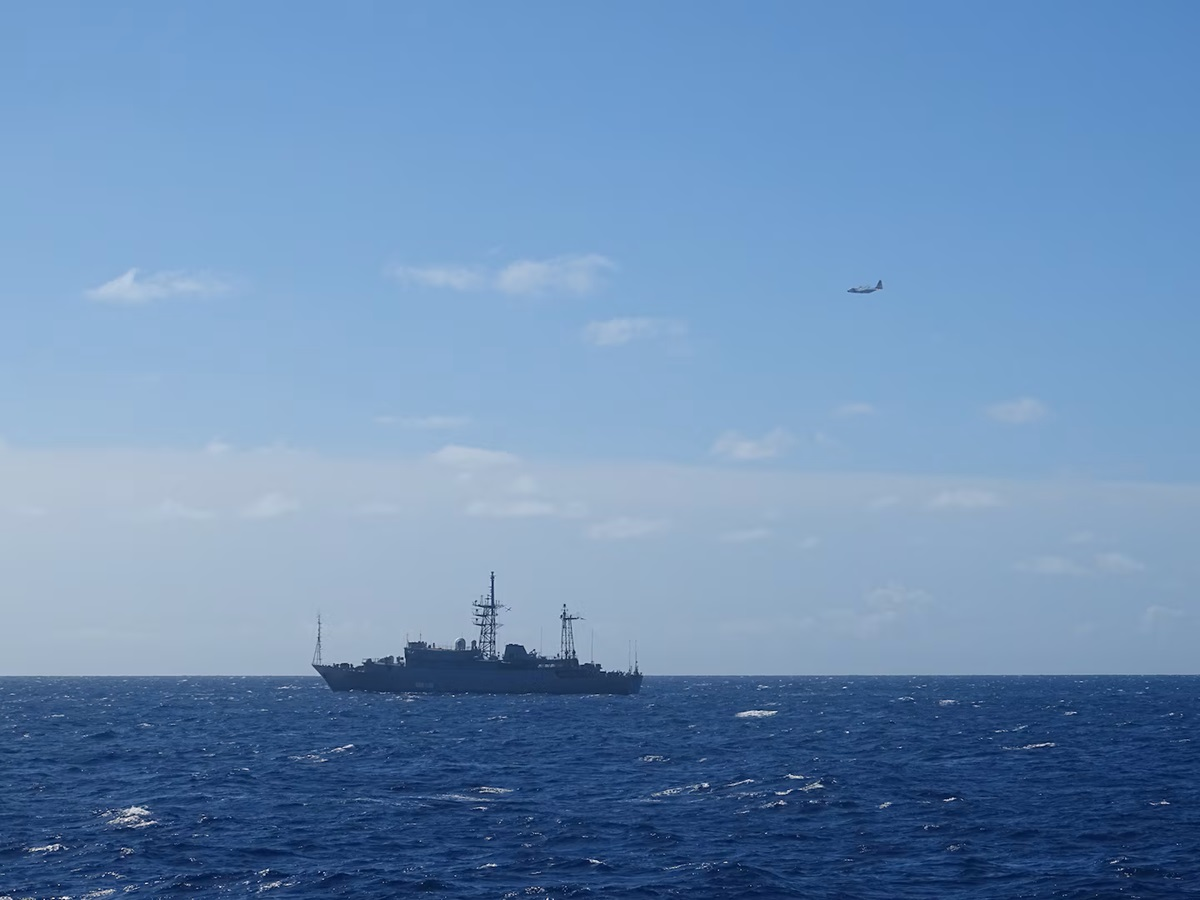
The U.S. Coast Guard detected and monitored the Russian intelligence ship Kareliya about 15 nautical miles south of Oahu on 29 October, deploying an aircraft and cutter to conduct a safe overflight and monitor its activities near U.S. territorial waters.
Image courtesy of US Coast Guard

SHARE ARTICLE

The U.S. Coast Guard detected a Russian military ship about 15 nautical miles south of Oahu on 29 October. A Coast Guard HC-130 Hercules aircraft and the cutter William Hart (WPC 1134) were sent to the area and flew over and sailed near the vessel. The ship was identified as the Russian Navy’s Kareliya, a Vishnya-class intelligence-gathering vessel.

Coast Guard crews monitored the ship in line with international law to keep nearby U.S. vessels safe and to support homeland defense. Capt. Matthew Chong of the Coast Guard Oceania District said the service regularly watches ship activity around the Hawaiian Islands and across the Pacific, working with partners and allies when foreign military vessels come close to U.S. territorial waters.

The Oceania District also works with U.S. Indo-Pacific Command and other agencies to track foreign military ships near U.S. territorial seas, including the waters around Guam and American Samoa. Under customary international law, foreign military vessels may pass and operate outside another country’s territorial sea, which extends 12 nautical miles from shore.
Editorial Note:
This article was prepared with the assistance of AI tools to enhance clarity and efficiency.
All information has been reviewed and verified by the HMT News editor.
Three merchant vessels including MAYUREE NAREE, One Majesty, and Star Gwyneth were reportedly damaged on 11 March near the Strait of Hormuz, raising renewed concern over maritime security and crew safety in one of the world’s most critical shipping corridors.
The IMO has urged shipping companies to put crew safety first after attacks on merchant vessels in the Strait of Hormuz caused seafarer casualties. The agency also warned operators to use only confirmed information when making navigational decisions in the high-risk corridor.
Seafarers on IBF-covered ships can now refuse voyages through the Strait of Hormuz and the wider Middle East Gulf after the threat level reached its highest category. The new arrangement includes repatriation rights, two months of basic wage compensation, higher pay in the zone, and doubled compensation in death or disability cases.

Subscribe to HMT WEEKLY

Receive HMT WEEKLY in your mailbox.

Heavy Marine Transport News, Delivered Daily — Stay informed on shipping, offshore, and global logistics.

SECTION

INFORMATION

CONTACT

For general inquiries and to contact us,
please email: info@hmt-news.com