Samsung Heavy Industries has formalized an agreement with HSG Sungdong Shipbuilding to construct a series of Suezmax-class crude carriers, marking the first time the company has delegated the complete build of a vessel to a domestic shipyard outside its corporate group. Korean media reported that the contract was signed on 14 October, confirming that HSG Sungdong Shipbuilding will undertake the full construction of four units ordered by a Greek shipowner.
The two shipbuilders previously established a strategic cooperation framework in July to support a joint development structure within the national shipbuilding sector. Samsung Heavy Industries aims to enhance process efficiency by integrating work with mid-sized Korean yards and has already positioned teams responsible for production oversight and quality control at HSG Sungdong Shipbuilding. The number of dispatched personnel is expected to grow as the project advances.
Both companies plan to complete detailed engineering, major equipment procurement, and process simulations over roughly the next 18 months. Cutting of the first steel plates is scheduled for December 2026, a milestone that will also signify HSG Sungdong Shipbuilding’s return to full-scale shipbuilding after an eight-year pause. The initiative aligns with the yard’s broader plan to re-establish its presence in complete vessel construction.
Samsung Heavy Industries’ move reflects mounting pressure on its primary facilities. The Geoje yard recorded a dock utilization rate of 116% in the first half of the year. As of 7 November, the company held an orderbook of 125 vessels valued at about $26.9 billion, representing at least three years of work. To manage this workload, Samsung Heavy Industries is focusing on high-value LNG carriers and other premium projects at Geoje, while allocating tanker programs to external shipyards.
Chinese builders have previously played a major role in Samsung Heavy Industries’ outsourcing strategy. The company assigned a group of Suezmax newbuildings to PaxOcean Engineering Zhoushan Co. Ltd., retaining responsibility for design, performance guarantees and procurement, while the Chinese yard handled construction. Korean industry sources note that although Chinese shipyards offer price advantages, domestic partners may provide benefits in long-term coordination and quality management.
Industry observers emphasize that full-vessel outsourcing is designed as a multi-year collaborative model rather than a short-term arrangement, underscoring the relevance of proximity and production supervision—particularly at a time when Korea’s broader shipbuilding ecosystem has been under strain. In this context, Samsung Heavy Industries’ engagement with a Korean mid-sized yard is seen as supporting the stability of local supply-chain capacity.
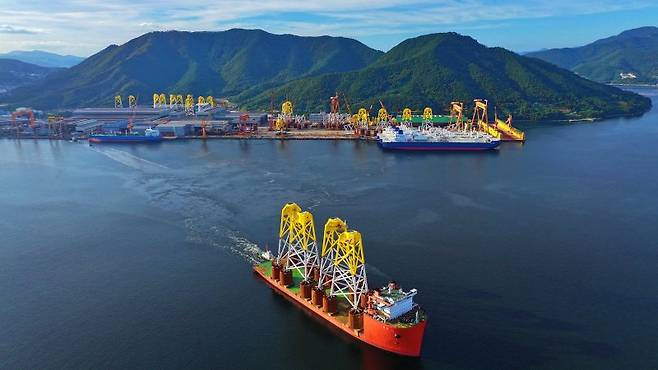
HSG Sungdong Shipbuilding, formerly Sungdong Shipbuilding & Marine Engineering, previously ranked among the world’s top ten builders and specialized in tanker construction. Although the yard faced challenges during the sector downturn in 2018, core assets and infrastructure remained intact. The shipyard maintains a construction approach that shortens schedules by assembling large hull blocks in the drydock, reducing heavy-lift requirements compared to other mid-sized yards.
After its acquisition by HSG Heavy Industries in 2020, the yard reoriented its business toward offshore wind infrastructure while continuing its long-standing cooperation with Samsung Heavy Industries, dating back to 1990. Its recent work on hull blocks and semi-hulls for Samsung Heavy Industries has laid the foundation for the transition to a full-vessel project.
With the shipowner’s approval secured, Samsung Heavy Industries will supervise key inspections, welding quality and process acceptance directly at the HSG Sungdong yard. The proximity between Geoje and Tongyeong is regarded as favorable for coordination. Within the Korean shipbuilding industry, the arrangement is seen as a potential indicator of a shift toward domestic tanker outsourcing, as mid-sized yards gradually restore newbuilding capacity and large-yard dock saturation persists.