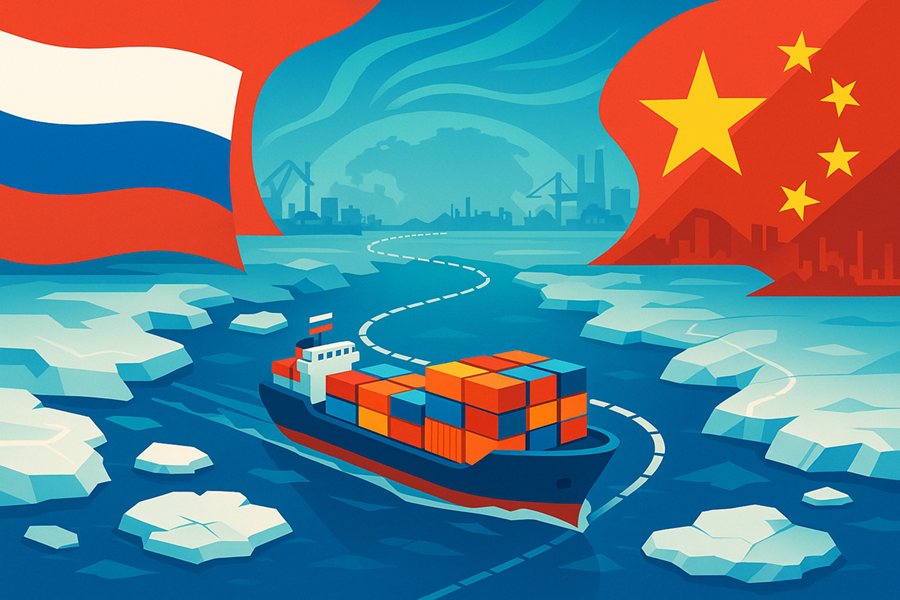
Russia and China have signed a cooperation framework agreement — a non-binding memorandum of understanding (MoU) — to jointly develop and commercialize the Northern Sea Route (NSR), a key Arctic maritime corridor linking Asia and Europe.
The signing took place in Harbin, China, during the China–Russia Expo, attended by Rosatom Director General Alexey Likhachev and China’s Minister of Transport Liu Wei. The agreement outlines intentions for infrastructure collaboration, investment, and joint research rather than constituting a legally binding intergovernmental treaty.
Rosatom described the deal as “a step toward systematic cooperation on Arctic transport development,” with Likhachev noting that it would “give further impetus to Russian-Chinese collaboration and future capital projects.”
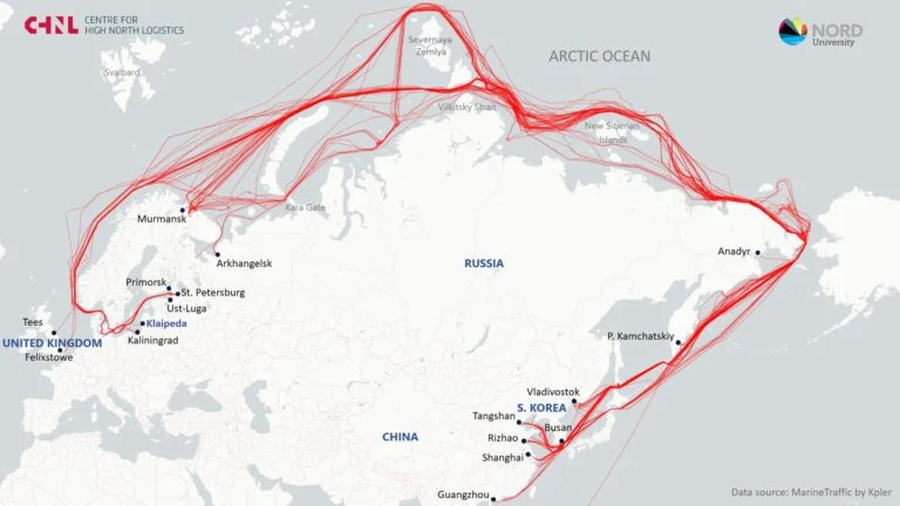
The Northern Sea Route, spanning over 5,600 km across Russia’s Arctic coast, offers the shortest maritime link between East Asia and Northern Europe. A recent voyage by a Chinese-operated Panamax containership reportedly completed the China–UK route in around 20 days, roughly half the time compared with the Suez Canal route (about 40 days). However, this figure originates from a single voyage report, and industry experts caution against generalizing the transit duration until more consistent data are available.
While both nations see the NSR as a strategic corridor for diversifying global trade, commercial navigation remains seasonal and limited due to ice conditions, infrastructure constraints, and insurance challenges. Russia continues to aim for year-round navigation by 2030, targeting 150 million tonnes of cargo throughput, with Chinese participation expected to accelerate progress.
China’s interest aligns with its Polar Silk Road vision — part of the Belt and Road framework — which promotes Arctic shipping as an alternative to congested southern routes.
Analysts view this MoU as another sign of deepening Russia-China cooperation in Arctic logistics, energy transport, and maritime research, though the agreement itself carries no binding legal obligations.
Likhachev stated that the initiative “lays the foundation for a sustainable Arctic transport system serving both Russian and international interests,” while Liu Wei highlighted it as “an important step under the Belt and Road cooperation framework to ensure stable maritime connectivity.”