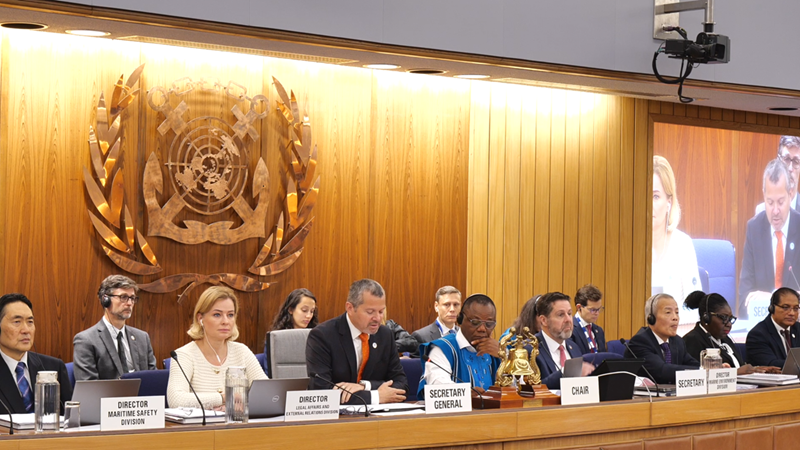
Following the International Maritime Organization’s (IMO) decision to postpone for one year the formal adoption of the MARPOL amendments under the Net-Zero Framework (NZF), legal and policy expert Sinem Ogis LL.M., Ph.D., Head of Legal at Siglar Carbon and a delegate to IMO MEPC & LEG, offered an interpretation of what the adjournment really means for the shipping industry.
According to Ogis, the IMO’s 2023 GHG Strategy remains in full effect, retaining its target of achieving net-zero greenhouse gas emissions from international shipping “by or around 2050.” She noted that the one-year delay does not alter member states’ commitments but may shift the timeline for NZF implementation and entry-into-force of associated instruments.
Ogis emphasized that such procedural pauses are not unprecedented in IMO’s history, pointing to earlier conventions like the Ballast Water Management Convention, which also underwent protracted negotiations. The challenge, she said, lies in balancing technical ambition with political consensus across the IMO’s diverse membership.
During this period, she expects regional initiatives to continue advancing independently. The EU’s ETS and FuelEU Maritime mechanisms are already operational and under review, while the UK, Türkiye, South Korea, and several African states—including Gabon and Djibouti—are developing national or regional market-based schemes.
Ogis described this situation as a “familiar reality,” where regional carbon regulations will keep shaping compliance obligations until a unified global carbon-pricing mechanism is achieved. Despite short-term fragmentation, she concluded, the long-term direction remains clear: the IMO’s GHG Strategy still provides the overarching framework toward global decarbonisation of shipping.