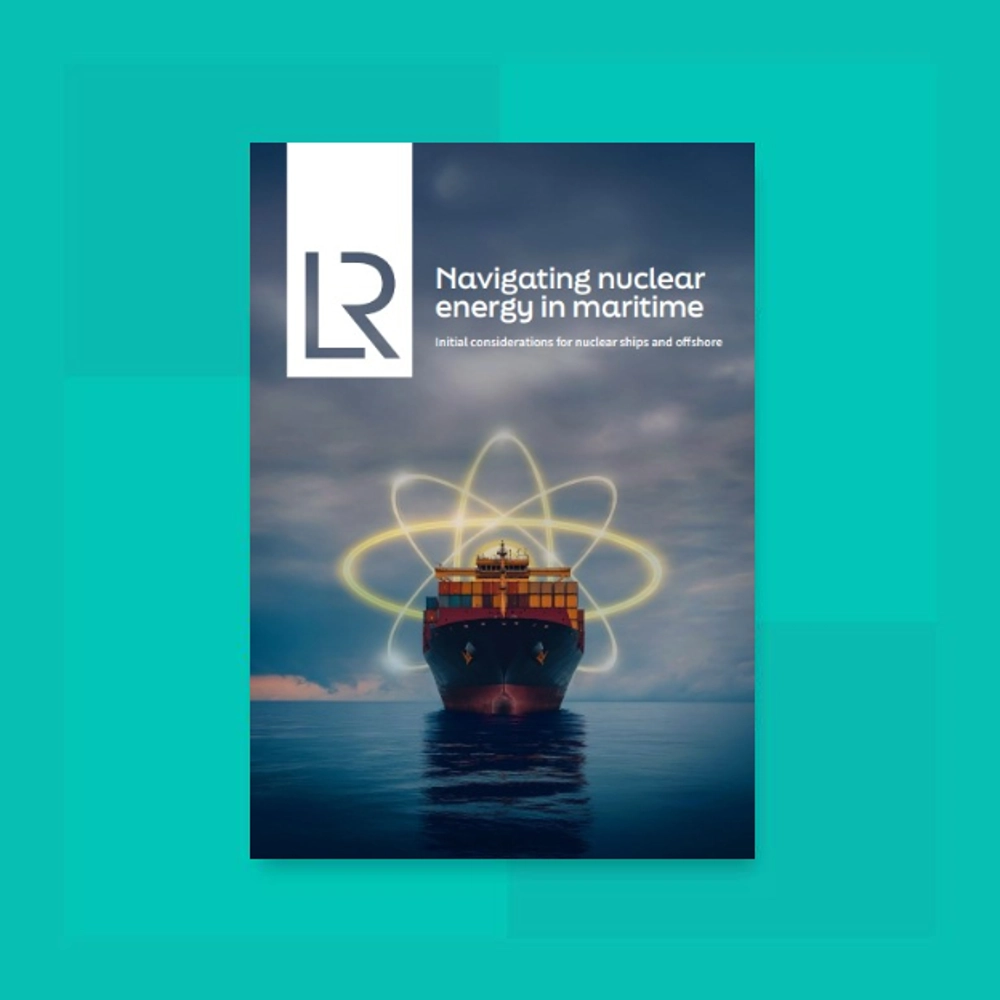
Lloyd’s Register (LR) has released new guidance providing the maritime industry’s first detailed framework for integrating nuclear energy into commercial shipping and offshore operations, marking a major step in the sector’s journey toward net-zero emissions.
The guidance note, Navigating Nuclear Energy in Maritime, was developed in collaboration with Global Nuclear Security Partners (GNSP) and marine insurer NorthStandard. It provides structured direction for project teams to integrate nuclear technologies — including small modular reactors (SMRs) — into maritime and offshore assets, addressing technical, regulatory, and financial challenges.
With international shipping accounting for nearly 3% of global greenhouse gas emissions, nuclear power has re-emerged as a potential zero-carbon alternative. Yet, despite decades of safe use in naval propulsion, no unified global regulatory framework currently exists for civilian nuclear-powered ships or offshore platforms.
The LR guidance aims to close this gap by defining the key steps toward safe and compliant deployment. It outlines best practices for regulatory alignment, safety case development, environmental assessment, security management, and insurance planning, while emphasizing collaboration between nuclear and maritime regulators.
The publication highlights the roles of the International Maritime Organization (IMO) and the International Atomic Energy Agency (IAEA), calling for harmonization between maritime and nuclear standards. It also addresses security and safeguards — including cyber protection, insider threat mitigation, and physical protection systems — as essential elements of nuclear maritime adoption.
“Nuclear energy has the potential to transform maritime, providing a scalable, zero-carbon energy source that accelerates the industry’s energy transition,”
said Mark Tipping, LR’s Global Power to X Director.
“But its success will depend on clarity, collaboration, and trust across regulators, operators, insurers, and the public. This guidance gives stakeholders a comprehensive foundation to navigate both risks and opportunities.”
Nick Tomkinson, Senior Partner at GNSP, underscored that safety, security, and safeguards — collectively known as the “3S principles” — must be embedded from project inception.
“Maritime nuclear will only succeed when these principles are considered together from the start,” he said. “This document helps first movers align frameworks, adopt goal-based approaches where prescriptive rules don’t yet exist, and build regulator and public confidence.”
From the insurance perspective, NorthStandard contributed insights into risk pooling, liability regimes, and the limitations of current Protection & Indemnity (P&I) structures in covering nuclear-related risks.
“We’re proactively supporting the industry in addressing insurance and regulatory challenges,” said Helen Barden, NorthStandard’s Director of External Affairs.
“Recognizing nuclear’s role in decarbonization is vital to ensure insurability and financial viability as this technology evolves.”
The 60-page guidance builds on LR’s Fuel for Thought: Nuclear research series and consolidates expertise from classification, safety, and nuclear security disciplines. It presents a step-by-step roadmap for adoption — from stakeholder engagement and financing to licensing and decommissioning — urging early collaboration among shipowners, regulators, insurers, and technology developers.
LR said it will continue working with industry partners and governments to advance nuclear readiness, develop goal-based standards, and ensure nuclear systems can be integrated safely into maritime operations.
Single-source: verified (Lloyd’s Register, 2025)